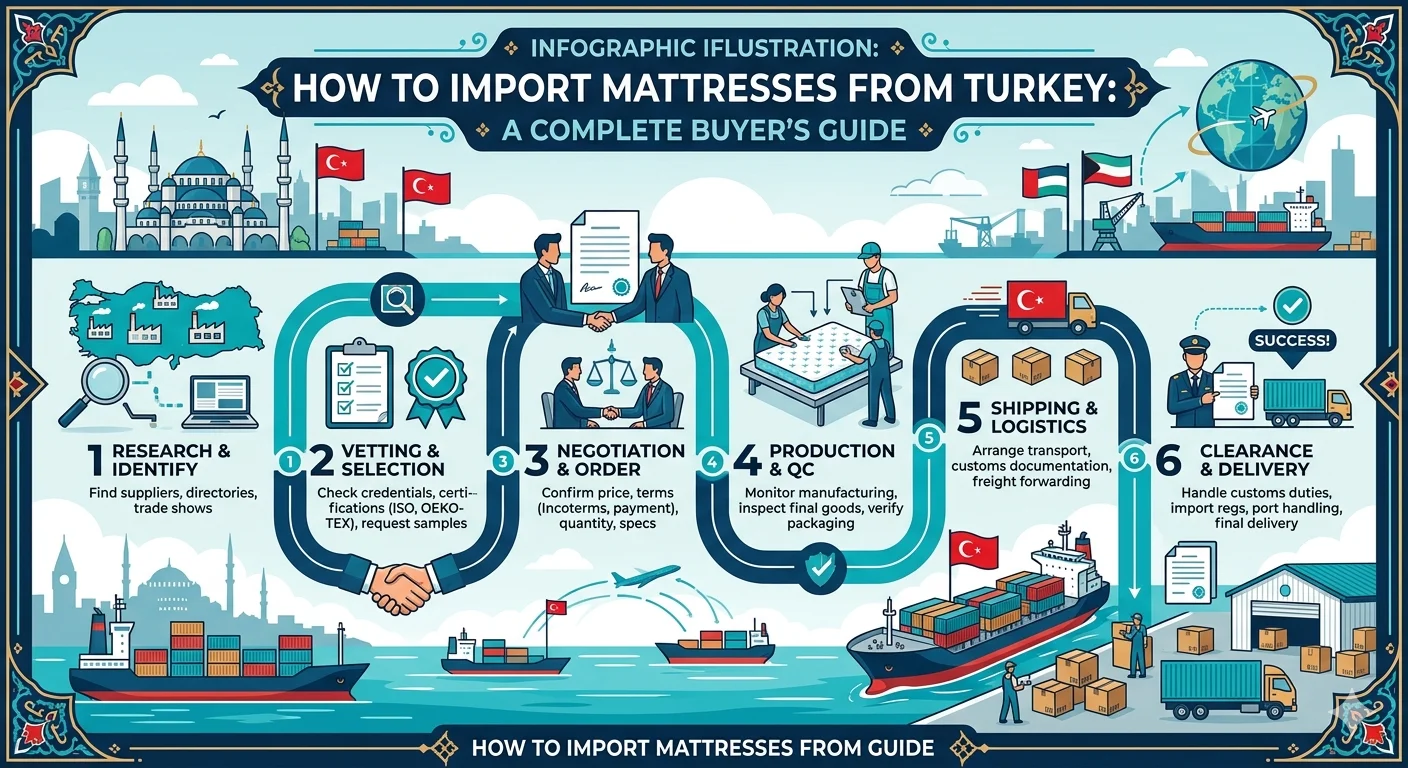
Turkey has firmly established itself as one of the world's leading mattress manufacturing and export hubs. Combining advanced production technology, premium raw materials, and competitive pricing, Turkish mattress manufacturers serve hotels, retailers, and distributors across more than 80 countries. If you are a hospitality buyer, wholesaler, or procurement manager looking to source quality mattresses at scale, this complete buyer's guide will walk you through every step of the import process.
1. Why Import Mattresses from Turkey?
Turkey's mattress industry benefits from decades of manufacturing expertise, vertically integrated supply chains, and strict quality controls aligned with EU standards. Key advantages include:
- Competitive factory pricing — Turkish manufacturers offer OEM and private-label production at significantly lower costs than Western European counterparts.
- Premium raw materials — Access to locally sourced natural latex, high-density foam, and pocket spring systems ensures consistent product quality.
- Custom sizing & branding — Most Turkish exporters accommodate bespoke dimensions, firmness ratings, and branded labelling for hospitality clients.
- Strategic location — Turkey's proximity to Europe, the Middle East, and Africa enables shorter transit times and reduced freight costs compared to Far East alternatives.
2. Choosing the Right Turkish Mattress Supplier
Not all manufacturers are equal. When evaluating suppliers, prioritise factories with verifiable export experience, international certifications (OEKO-TEX®, ISO 9001), and a transparent production process. Request product samples before committing to bulk orders and verify references from existing hotel or retail clients.
TurkishMattress.com — Berfa Group Turkey is among Turkey's top-ranked mattress exporters, supplying five-star hotels, FF&E contractors, and global distributors with a full range from Eco Series to Platinum collections. Their in-house export team manages documentation, compliance, and logistics from factory to destination port.
3. Understanding Import Regulations & Customs Requirements
Importing mattresses is generally straightforward, but customs compliance is critical. The HS Code for mattresses is 9404.21 (spring mattresses) or 9404.29 (other mattresses). Key documentation you will need includes:
- Commercial Invoice & Packing List
- Bill of Lading or Airway Bill
- Certificate of Origin (EUR.1 for EU preferential tariff eligibility)
- Product compliance certificates (fire retardancy standards vary by destination country)
- Import permit (if required in your country)
Turkey has a Customs Union with the EU, which simplifies documentation for European buyers. For buyers in the Middle East, South Asia, or Africa, import duties and VAT will vary — consult a licensed clearing agent in your destination country for accurate tariff classifications.
4. Shipping Methods: Ocean Freight vs. Air Freight
Given their size and weight, mattresses are almost exclusively shipped by ocean freight. A standard 20ft container can hold approximately 100–150 mattresses depending on dimensions and compression packing. A 40ft high-cube container roughly doubles that capacity. For smaller orders, Less-than-Container Load (LCL) consolidation is a cost-effective option that lets you share container space with other shippers.
Major Turkish export ports include Mersin, Izmir, and Istanbul (Ambarli). Typical transit times to key markets: 7–10 days to GCC ports, 12–18 days to East Africa, and 18–25 days to South and Southeast Asia. Air freight is rarely used for mattresses but may apply to urgent sample shipments or premium hotel opening projects with tight deadlines.
5. Minimum Order Quantities & Pricing
Most Turkish mattress exporters set a minimum order quantity (MOQ) of one full container (FCL) for the best factory pricing. However, reputable exporters like Berfa Group Turkey accommodate smaller trial orders via LCL consolidation for new buyers. Typical FOB Turkey pricing ranges from USD 80–350 per unit depending on specifications — pocket spring, memory foam, latex, or hybrid — and any custom branding requirements.
Always request quotes on FOB (Free on Board) or CIF (Cost, Insurance & Freight) terms. CIF pricing includes freight and insurance to your destination port, making cost comparison easier. Factor in import duties, destination handling charges, and last-mile delivery when calculating your total landed cost.
6. Quality Control & Pre-Shipment Inspection
Quality assurance is non-negotiable for large import orders. Before shipment, arrange a pre-shipment inspection (PSI) either through your supplier's in-house QC team or a third-party inspection agency such as SGS or Bureau Veritas. Check for correct firmness ratings, stitching quality, fabric specifications, and accurate labelling. Any defects identified pre-shipment are far cheaper to resolve than post-arrival disputes.
7. Payment Terms for Turkish Mattress Imports
Common payment terms between Turkish exporters and international buyers include:
- 30% deposit, 70% before shipment — Most common for new buyer relationships.
- Letter of Credit (L/C) — Preferred for large orders; provides financial protection for both parties.
- 100% T/T in advance — Sometimes offered for discounted pricing on small sample orders.
Build trust gradually with your supplier before negotiating deferred payment terms. A reliable export partner will be transparent about production schedules and provide regular shipment updates.
8. Working with a Freight Forwarder
An experienced freight forwarder simplifies the entire import process — from booking ocean freight and preparing shipping documents to handling customs clearance at the destination port. Look for a forwarder with established relationships with Turkish shipping lines and familiarity with your destination country's customs procedures. Explore more logistics insights and import guides on the TurkishMattress.com Blog.
Final Thoughts
Importing mattresses from Turkey is a highly viable strategy for hospitality buyers, retailers, and distributors seeking quality products at competitive prices. The key to a smooth import experience lies in thorough supplier vetting, clear documentation, and working with trusted logistics partners. Whether you are sourcing for a hotel chain opening, a retail distribution network, or a private-label brand, TurkishMattress.com — Berfa Group Turkey offers the manufacturing expertise, export experience, and product range to meet your needs reliably and at scale.
Frequently Asked Questions
Why should I import mattresses from Turkey instead of other countries?
Turkey offers a rare combination of European-standard manufacturing quality and highly competitive factory-direct pricing, plus a strategic location with fast shipping access to Europe, the Middle East, Africa and beyond.
What is the minimum order quantity (MOQ) for importing mattresses from Turkey?
MOQs vary by manufacturer and mattress type, but most Turkish suppliers, including Berfa Group, can accommodate orders from a single container load, with tiered pricing that rewards larger volumes.
How long does it take to import mattresses from Turkey?
Production typically takes 3–6 weeks depending on order size and specification, followed by 5–10 days for road freight to Europe or longer transit times for sea freight to more distant markets.
What shipping method is best for importing mattresses — sea or air freight?
Sea freight (FCL or LCL) is the standard and most cost-effective method for bulk mattress imports, while air freight is reserved for urgent, smaller sample or rush orders due to its significantly higher cost.
Do imported Turkish mattresses meet international safety and quality standards?
Reputable Turkish manufacturers comply with EU flammability, chemical content and labelling regulations, and can provide certifications such as OEKO-TEX, ISO and CE marking on request.